
Landscape Lighting Timers
What Is a Landscape Lighting Timer?
Fully updated for 2026
Landscape lighting timers are control devices installed in low-voltage (12V) outdoor lighting systems that automatically turn fixtures on and off based on set schedules, sunset/sunrise calculations, or ambient light levels.
In most systems, the timer integrates directly into the landscape lighting transformer, which serves as the control hub for the entire layout — including tree uplighting, path lights, and in-ground fixtures.
A properly selected timer:
Ensures lights turn on and off consistently
Prevents fixtures from running all night
Adjusts for seasonal daylight changes
Reduces electricity use
Extends LED fixture lifespan
For most homes, automated control is essential for maintaining a refined, low-maintenance nightscape.
Types of Landscape Lighting Timers (2026 Comparison)
There are five primary timer options used in modern 12V systems.
1. Mechanical (Analog) Landscape Lighting Timers
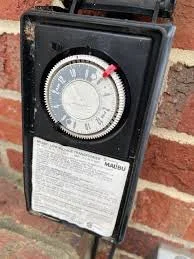
Mechanical timers use a physical dial with pins or segments to determine on/off times.
Best For: Basic or budget installations
Advantages:
Reliable and durable
Inexpensive
Simple to operate
Limitations:
Requires manual seasonal adjustment
No automatic dusk/dawn calculation
This is a practical solution for straightforward systems with minimal adjustment needs.
2. Digital / Programmable Landscape Lighting Timers
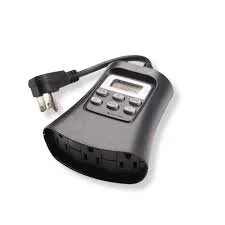
Digital timers use an LCD interface to allow daily or weekly scheduling.
Best For: Homeowners needing defined schedules
Advantages:
Flexible programming options
Battery backup retains settings
More precise control
Limitations:
Still requires seasonal updates
Must manually adjust for daylight shifts
A solid middle-ground option for controlled runtime scheduling.
3. Astronomical Landscape Lighting Timers (Recommended)
Astronomical timers calculate local sunset and sunrise based on geographic location and automatically adjust throughout the year.
Best For: Most professionally installed low-voltage systems
Advantages:
Automatic seasonal syncing
Adjusts for Daylight Saving Time
True “set-and-adjust-once” operation
No manual daylight recalibration
Limitations:
Slightly higher initial cost
For most properties, this is the best landscape lighting timer for reliable, low-maintenance performance.
4. Photocell (Dusk-to-Dawn) Sensors
Photocell sensors activate lighting based on real-time ambient light levels.
Best For: Simple dusk-to-dawn automation
Advantages:
Automatically responds to light conditions
No programming required
Limitations:
Can be affected by nearby lighting or shade
Less precise than astronomical timers
Photocells are often paired with a timer to provide layered control.
5. Smart Landscape Lighting Controls (App-Based)
Smart systems connect via Wi-Fi or Bluetooth and allow app-based management.
Best For: Homeowners wanting zoning and remote control
Advantages:
Adjust lighting from anywhere
Create lighting zones
Dim fixtures late at night
Vacation and event settings
Integration with home automation systems
Limitations:
Requires reliable Wi-Fi
Higher upfront investment
Ideal for modern homes seeking advanced outdoor lighting automation.
Landscape Lighting Timer Comparison Table
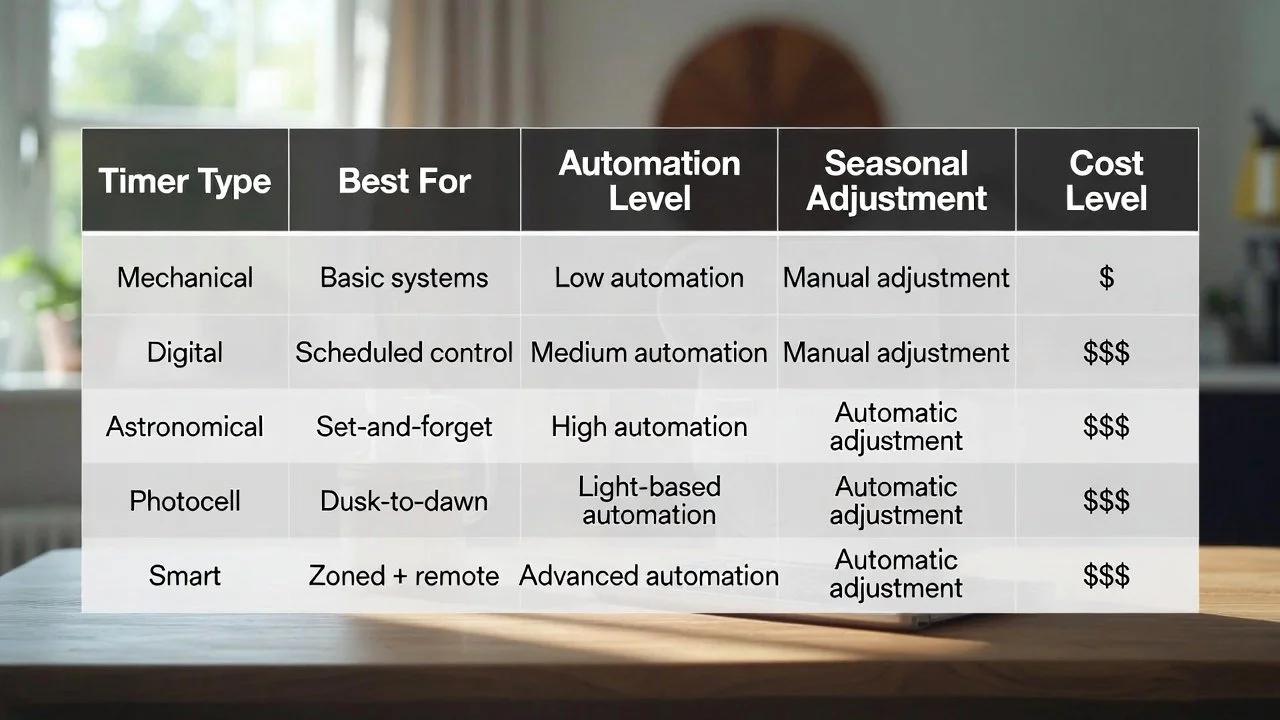
Timer Comparisons
Best Timer for Tree Uplighting & In-Ground Fixtures
For most residential properties, an astronomical timer integrated into the transformer offers the best balance of reliability and simplicity.
Typical setup:
Lights turn on automatically at dusk
Run 4–8 hours per evening
Shut off late evening or at dawn
No seasonal adjustments required
This ensures consistent curb appeal without excessive runtime.
For additional flexibility:
Pair with a photocell for layered control
Upgrade to a smart transformer for zoning or remote access
Use UL-listed, weather-rated equipment
Ensure the transformer is properly protected and sized
Do Landscape Lighting Timers Save Electricity?
Yes. By limiting runtime and preventing overnight operation, timers:
Reduce wasted electricity
Extend LED lifespan
Lower transformer strain
Improve long-term system performance
Most LED landscape lighting systems, when run 4–8 hours nightly, maintain modest operating costs while delivering a polished nighttime aesthetic.
Frequently Asked Questions
What is the best timer for landscape lighting?
For most 12V systems, an astronomical timer is the most reliable solution. It automatically adjusts for seasonal daylight changes and requires minimal maintenance.
Can I add a timer to an existing landscape lighting transformer?
Yes. Many low-voltage transformers allow timer upgrades. Compatibility depends on transformer type and available control ports.
Should landscape lights stay on all night?
In most residential settings, no. Running lights 4–8 hours after sunset provides visibility and aesthetic impact without unnecessary energy use.
What’s the difference between an astronomical timer and a photocell?
An astronomical timer calculates sunset/sunrise using geographic data. A photocell reacts to real-time light levels. Astronomical timers are more precise and less susceptible to interference.
Professional Landscape Lighting Timer Installation
Selecting the right landscape lighting timer depends on:
Transformer capacity
Fixture count
Desired runtime
Property size
Lighting zones
Automation preferences
A properly configured control system keeps your outdoor lighting consistent, energy-efficient, and effortless year-round. This is where professional landscape lighting designers from Hamptons Landscape Lighting com in.
If you’re unsure which landscape lighting timer works best for your 12V system, we can evaluate your transformer, fixture layout, and runtime goals to recommend a reliable, low-maintenance solution.