
Dark Sky Landscape Lighting in Quogue
Quogue’s appeal is closely tied to its quiet residential streets, mature landscapes, coastal setting, and understated character.
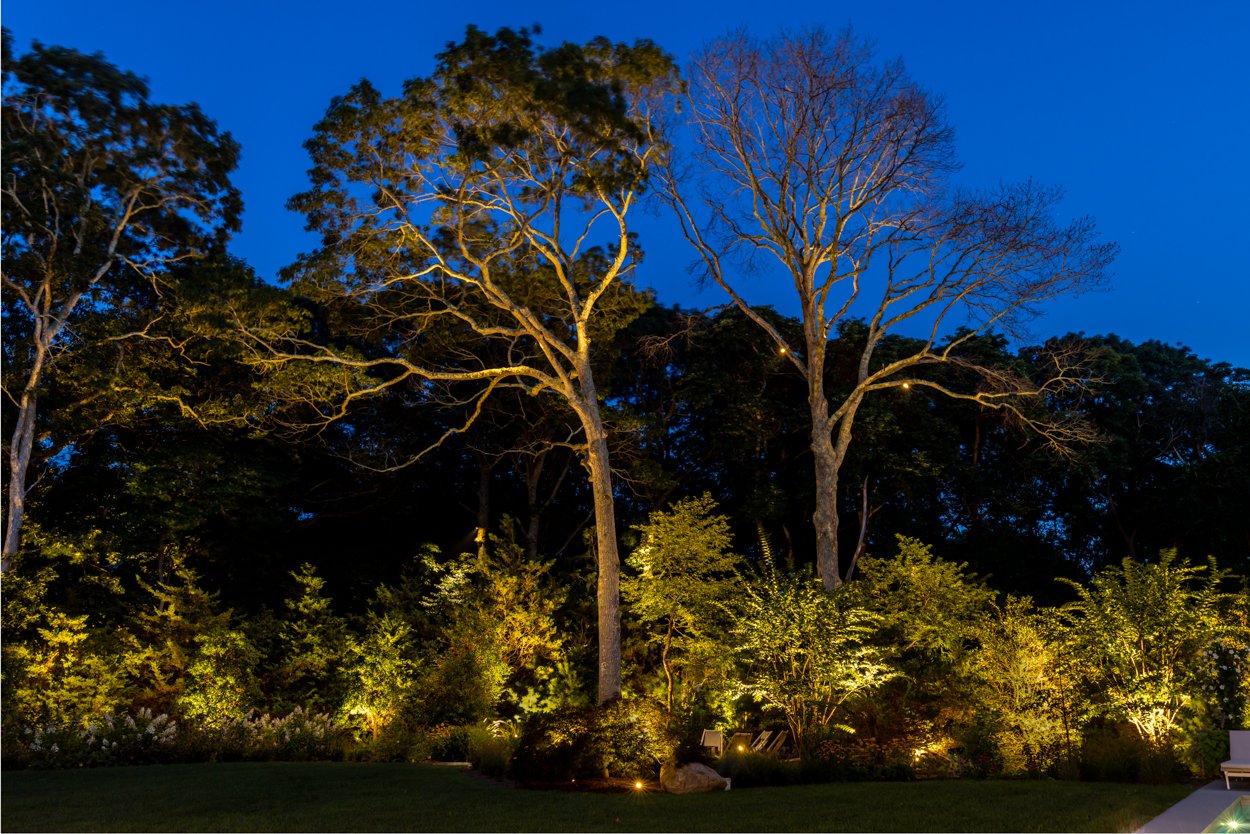
Outdoor lighting that is excessively bright, poorly aimed, or left operating throughout the night can work against that character. It can also create glare for drivers and pedestrians, spill into neighboring homes, and reduce the visual comfort of the property it was intended to improve.
Quogue’s lighting standards focus on nuisance lighting, glare, light trespass, floodlights, spotlights, and unnecessary overnight operation.
Why Glare Matters as Much as Brightness
Glare occurs when the light source itself is visible or when a bright beam enters the viewer’s field of vision.
It can come from:
Exposed path-light lamps
Wall fixtures mounted too high
Floodlights aimed outward
Spotlights pointed toward the road
Fixtures visible through neighboring windows
Pool and patio lighting reflected in glass
Bright driveway lights surrounded by otherwise dark areas
Glare does not improve security or visibility. It can reduce both by forcing the eye to adjust to an unnecessarily bright source.
How HLL Approaches Quogue Properties
Hamptons Landscape Lighting begins with a nighttime-use plan.
We identify where people actually need light: entrances, steps, paths, gates, parking areas, pool access, dining areas, and transitions between outdoor spaces. We then separate those needs from purely decorative lighting.
Our Quogue designs typically include:
Warm 2700K or lower light
Shielded fixtures that conceal the lamp
Downlighting where an appropriate mounting location exists
Low-output step, path, and marker lights
Tightly controlled accents for selected trees and plantings
No broad beams aimed toward roads or neighboring properties
Timed shutoff for nonessential lighting
Motion activation for appropriate security applications
We avoid relying on high-output floodlights to illuminate large areas. Several carefully positioned, lower-output fixtures usually provide better visibility with less glare.
Designing Around Mature Landscapes
Quogue properties often include hedges, established trees, layered gardens, and natural buffers. These features can help conceal fixtures, but they can also change the lighting pattern over time.
A beam that is properly contained in spring may be blocked by foliage in summer. A fixture may then be repositioned too far outward, creating off-property spill. Landscape maintenance can also shift or expose fixtures.
HLL documents the intended direction of every beam and revisits the system as the landscape changes. Through ongoing maintenance, we correct fixture positions rather than simply increasing output.
Pool, Patio, and Entertaining Scenes
Outdoor entertaining requires more light than a property needs at 1:00 a.m.
HLL creates separate scenes so homeowners can use a brighter, layered setting during dinner or a gathering and then transition to a restrained late-evening scene. Decorative landscape and entertaining zones can turn off automatically while selected circulation or entrance lighting remains available.
This supports Quogue’s restrictions on unnecessary continuous overnight illumination and creates a more comfortable property.
A Quieter Nighttime Composition
A successful Quogue lighting design should not make the entire property visible at once.
It should provide a controlled sequence: an inviting entry, a readable path, a softly defined terrace, and selected landscape moments surrounded by darkness.
That use of restraint is not only dark sky friendly. It is what gives residential landscape lighting depth, atmosphere, and a sense of place.