
Dark Sky Landscape Lighting in Riverhead
Riverhead includes a broad mix of residential neighborhoods, rural parcels, farms, commercial corridors, waterfront areas, and properties that serve as a transition between the North and South Forks.
Because those conditions vary, outdoor lighting cannot be approached with a single fixture package or brightness level.
The Town of Riverhead’s exterior-lighting regulations are intended to reduce glare, light trespass, skyglow, and over-lighting. The rules can affect new exterior lighting and certain existing fixtures when they are replaced, altered, repaired, or relocated.
Why a Lighting Plan Matters
Exterior-lighting compliance is not determined only by the appearance of a fixture the.
A proper plan considers:
Fixture output
Photometric distribution
Mounting height
Beam direction
Color temperature
Property-line conditions
Hours of operation
Controls
Interaction between overlapping beams
A fixture may look shielded in a catalog photograph but produce glare when mounted too high or tilted outward. Several individually low-output fixtures may also create excessive brightness when their beams overlap.
HLL’s Riverhead Design Process
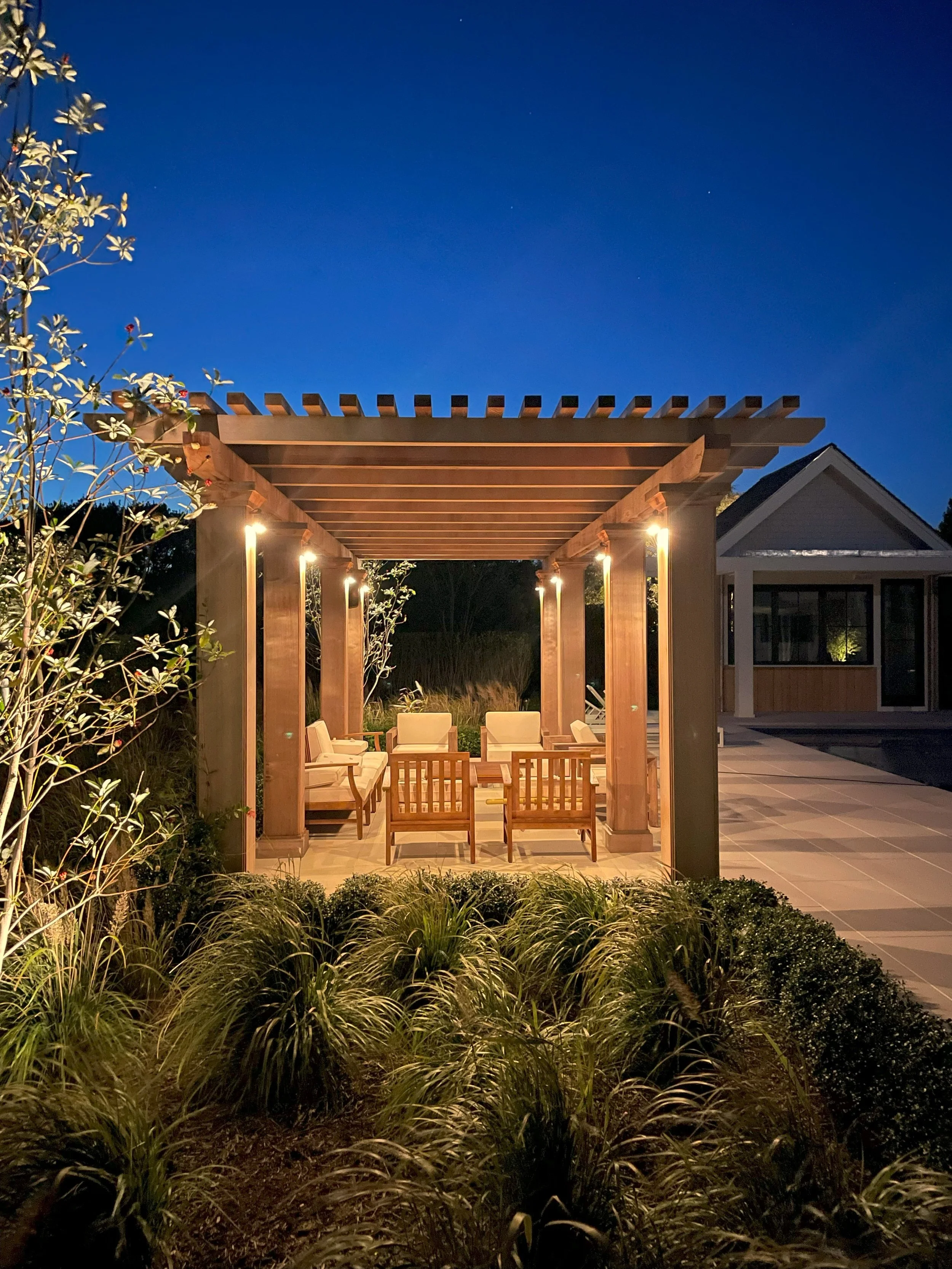
Hamptons Landscape Lighting prepares a fixture-by-fixture plan that connects each light to a specific purpose.
Our Riverhead designs prioritize:
Warm 2700K or lower light
Fully shielded and downward-directed fixtures
Minimal uplight
Low mounting heights
No visible lamp source from roads or neighboring properties
Output appropriate to the task
Timers, dimming, and motion controls
Separate essential and nonessential lighting zones
Documented beam direction
Professional nighttime aiming
Where a project requires municipal or Planning Board review, fixture cut sheets, aiming notes, schedules, and other lighting information can be organized for coordination with the project architect, engineer, builder, electrician, or reviewing department.
Residential Properties Near Commercial Areas
Some Riverhead homes are affected by surrounding roadway or commercial lighting.
The answer is not to make the residential property equally bright. Adding more light can reduce contrast in one direction while creating harsher glare elsewhere.
HLL uses layered, lower-level illumination to make entrances and walking surfaces readable without turning the home into another brightly illuminated site. Strategic screening and shielding can also prevent exterior fixtures from contributing to the existing skyglow.
Rural, Farm, and Waterfront Properties
On open properties, fixtures can be visible from a considerable distance. We use controlled optics and avoid aiming beams toward roads, fields, water, or neighboring residences.
Near the Peconic River, bays, ponds, and wetlands, warmer light and lower output may be appropriate even when not explicitly required. These choices reduce reflection and help preserve the surrounding nighttime environment.
Commissioning the System After Dark
The installed system must be evaluated at night.
HLL checks the property from important viewpoints, including the road, property boundaries, neighboring directions, interior windows, and waterfront areas. Fixtures are then aimed, shielded, or dimmed as needed.
Riverhead’s varied settings require a lighting plan that responds to the exact property. With warm light, controlled optics, documented aiming, and sensible operating schedules, exterior lighting can improve safety and atmosphere without adding unnecessary brightness to the night.