
Sagaponack Dark Sky Lighting: Designing for One of the Hamptons’ Most Restrictive Villages
Sagaponack’s open farmland, broad views, quiet roads, oceanfront properties, and low-density residential character make darkness part of the village’s identity.
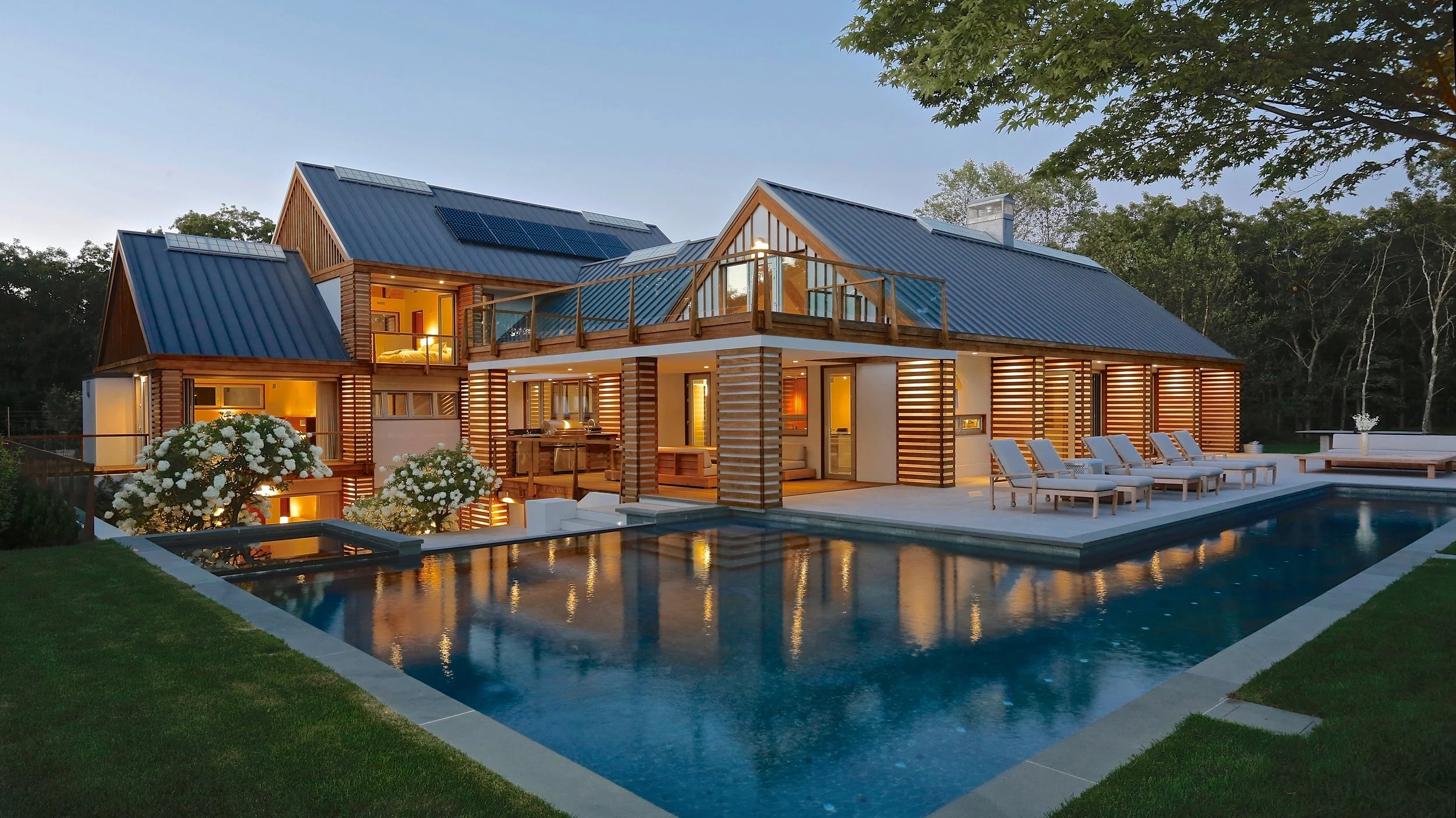
Outdoor lighting must therefore do more than illuminate a property. It must preserve the surrounding nighttime environment.
Sagaponack maintains particularly detailed exterior-lighting standards addressing fixture output, total site illumination, mounting height, aiming, color temperature, tree lighting, motion controls, light trespass, and overnight operation. The Village’s 2026 lighting amendment moved the required shutoff time for exterior lighting not required by law to 11:00 p.m.
For homeowners, this makes early lighting design especially important.
What Sagaponack’s Lighting Rules Are Intended to Prevent
Poorly controlled lighting can be visible across unusually long distances in Sagaponack. A bright fixture near a driveway, tree, roofline, or pool may affect:
Neighboring properties
Public roads
Agricultural views
Beaches and dunes
Ponds and wetlands
Ocean and water views
The wider night sky
Sagaponack’s regulations are designed to limit that impact. The rules may apply not only to new construction but also when existing fixtures are replaced, repaired, relocated, altered, or relamped.
Changing an older lamp to a brighter LED is not necessarily a simple maintenance decision. It can materially change the fixture’s output, color, distribution, and off-property visibility.
How HLL Approaches a Sagaponack Lighting Design
Hamptons Landscape Lighting treats Sagaponack as a strict dark-sky design environment.
Our preferred approach is intentionally conservative:
2700K or warmer light
2200K to 2400K for selected low-level landscape applications
Fixtures substantially below the maximum permissible output wherever possible
Fully shielded and downward-facing fixtures
No visible lamp source from roads, neighboring properties, beaches, or waterways
Minimal and carefully controlled uplighting
Automatic shutoff of nonessential exterior lighting by 11:00 p.m.
Lower late-evening lighting scenes before full shutoff
Precise control of motion-sensor detection areas
We consider fixture height, output, optics, and aiming together. A low-output fixture can still create glare when installed at the wrong angle. A shielded fixture can still cause spill if it is positioned too close to a boundary or aimed across an open landscape.
Tree and Architectural Lighting Require Particular Care
Tree lighting can be especially visible in Sagaponack because illuminated canopies may appear against an otherwise dark horizon.
When tree lighting is appropriate and allowable, HLL limits the number of illuminated specimens and selects each beam for a specific trunk or canopy. We avoid broad beams that illuminate several trees, project beyond the intended foliage, or contribute unnecessary uplight.
We apply the same restraint to architecture. Roofline lighting, broad façade washing, and excessive wall illumination can make a residential property appear commercial. Selected downlighting, low-level step lighting, and subtle illumination of entrances often produce a more refined result.
A Fixture-by-Fixture Plan for Municipal Review
Sagaponack projects benefit from thorough documentation. An HLL lighting plan can identify:
Every proposed exterior fixture
Manufacturer and model
Wattage and lumen output
Kelvin temperature
Mounting height
Beam angle
Aiming direction
Control zones
Required shutoff schedules
We coordinate the lighting plan with the homeowner, architect, landscape architect, builder, electrician, pool contractor, and other project professionals. When municipal confirmation or review is required, the team has a defined plan rather than a collection of loosely selected fixtures.
Nighttime Aiming Is Essential
A plan establishes design intent, but the final result must be evaluated after dark.
HLL professionally aims each fixture to verify that the lamp source is concealed, the beam remains within the intended area, and lighting is not visible where it should not be. Controls are then programmed to enforce the required 11:00 p.m. shutoff and any earlier dimming scenes.
The best Sagaponack lighting does not announce itself. It quietly supports movement, outdoor living, and selected landscape features while allowing darkness to remain the dominant nighttime experience.