
Town of East Hampton Dark Sky Lighting: What Homeowners Should Plan For
The Town of East Hampton includes Amagansett, Montauk, Springs, Wainscott and other unincorporated areas outside the Village of East Hampton.
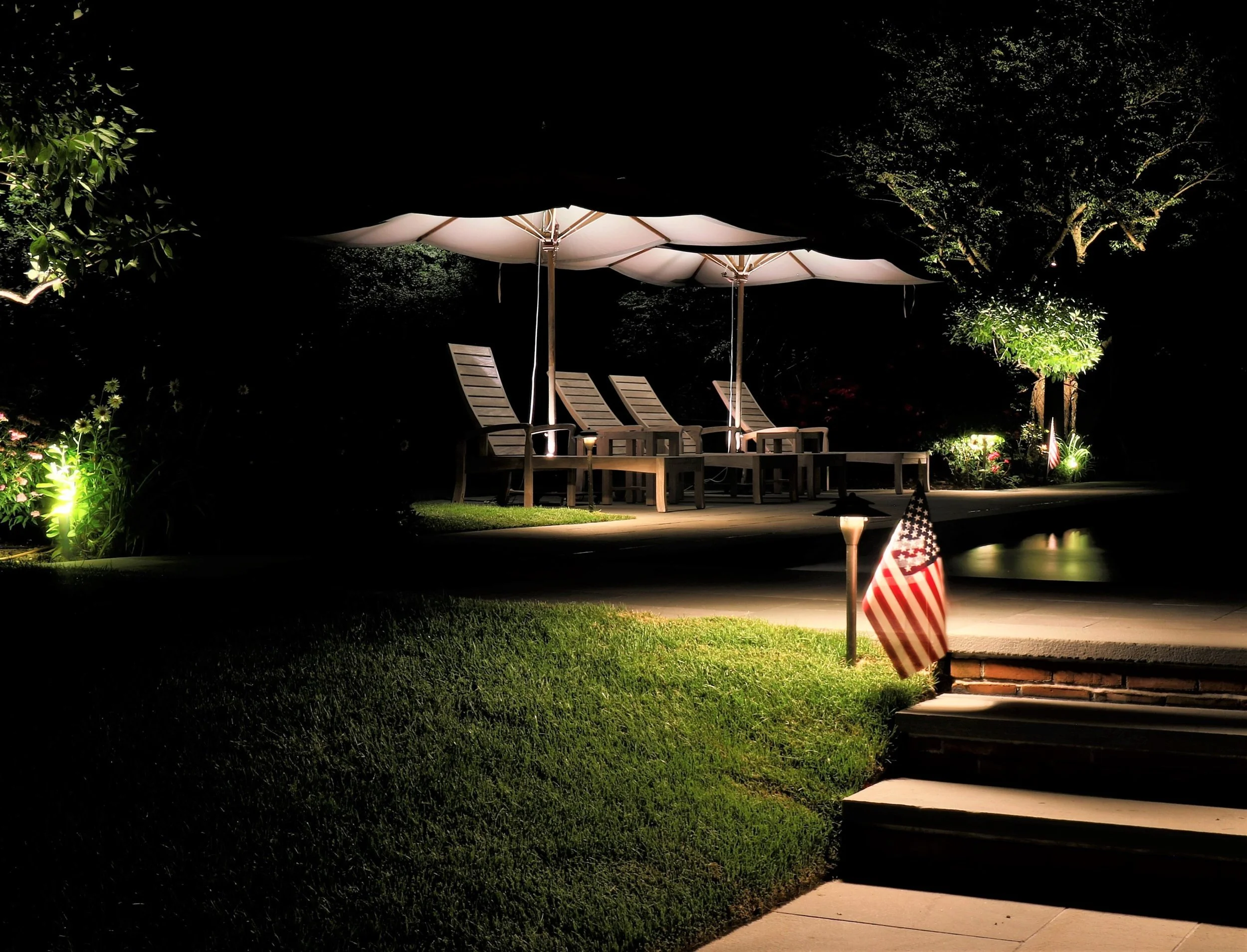
Across those communities, outdoor lighting must respond to very different property conditions: wooded lots, oceanfront homes, harbor properties, preserved land, compact neighborhoods, large estates, and open landscapes.
The Town’s lighting standards are designed to reduce glare, light trespass, skyglow, excessive brightness, and unnecessary daytime or late-night illumination.
Important Landscape-Lighting Standards
The Town’s current framework places particular emphasis on landscape and tree lighting.
Applicable requirements include:
Warm light for landscape applications
Limits on the initial lumens produced by individual fixtures
Shielding of foliage and landscape-feature lighting
Restrictions on off-property visibility
An 11:00 p.m. shutoff for nonessential landscape and tree lighting
Strictly controlled uplighting of individual trees
Restrictions on day-burning landscape lighting
Additional limitations for driveway fixtures near property lines
These requirements make fixture selection only one part of compliance. Placement, beam spread, shielding, aiming, and controls matter just as much.
How HLL Designs Within the Town’s Constraints
Hamptons Landscape Lighting prepares a fixture-by-fixture plan rather than selecting a general family of fixtures and deciding placement during installation.
For each fixture, we consider:
What is being illuminated
Why that area needs light
The required lumen output
The appropriate color temperature
The narrowest useful beam spread
Whether the lamp source will be visible off-property
Whether additional shielding or louvers are needed
Which control zone the fixture belongs to
When the fixture should dim or turn off
We commonly specify 2700K, 2400K, or 2200K lighting depending on the application and environmental sensitivity of the property.
Tree Lighting Should Be Selective
The Town’s approach to tree uplighting reinforces a principle HLL already follows: one fixture should not broadly illuminate several trees and the surrounding sky.
When tree lighting is allowable, we select individual specimens that contribute to the composition. Fixtures are placed close to the intended tree, aimed tightly, and shielded from off-property views.
Not every tree needs light. Darkness around a selected specimen gives the illuminated tree greater depth and presence.
Controls Are Part of Compliance
A lighting design is incomplete without a documented operating schedule.
HLL can create separate zones for:
Walkways and steps
Entrances
Pools and terraces
Landscape accents
Decorative landscape and tree lighting can be programmed to turn off automatically by 11:00 p.m. Earlier dimming scenes can reduce brightness after entertaining ends, while appropriate essential lighting remains available.
Systems can be integrated with Lutron, Savant, Control4, or other compatible control platforms when the property’s broader technology plan supports it.
Nighttime Aiming and Ongoing Maintenance
Even a compliant fixture can create glare if it is incorrectly aimed.
HLL professionally aims every system after dark and evaluates visibility from roads, neighboring properties, water, and important interior viewpoints.
Over time, landscaping grows, fixtures move, and control schedules drift. Brilliance Care™ provides ongoing cleaning, repositioning, re-aiming, schedule verification, and system maintenance.
The Town of East Hampton’s dark sky standards encourage exactly the kind of lighting HLL believes works best: warm, controlled, documented, carefully aimed, and present only when it is needed.