
Brownstone Lighting Repairs
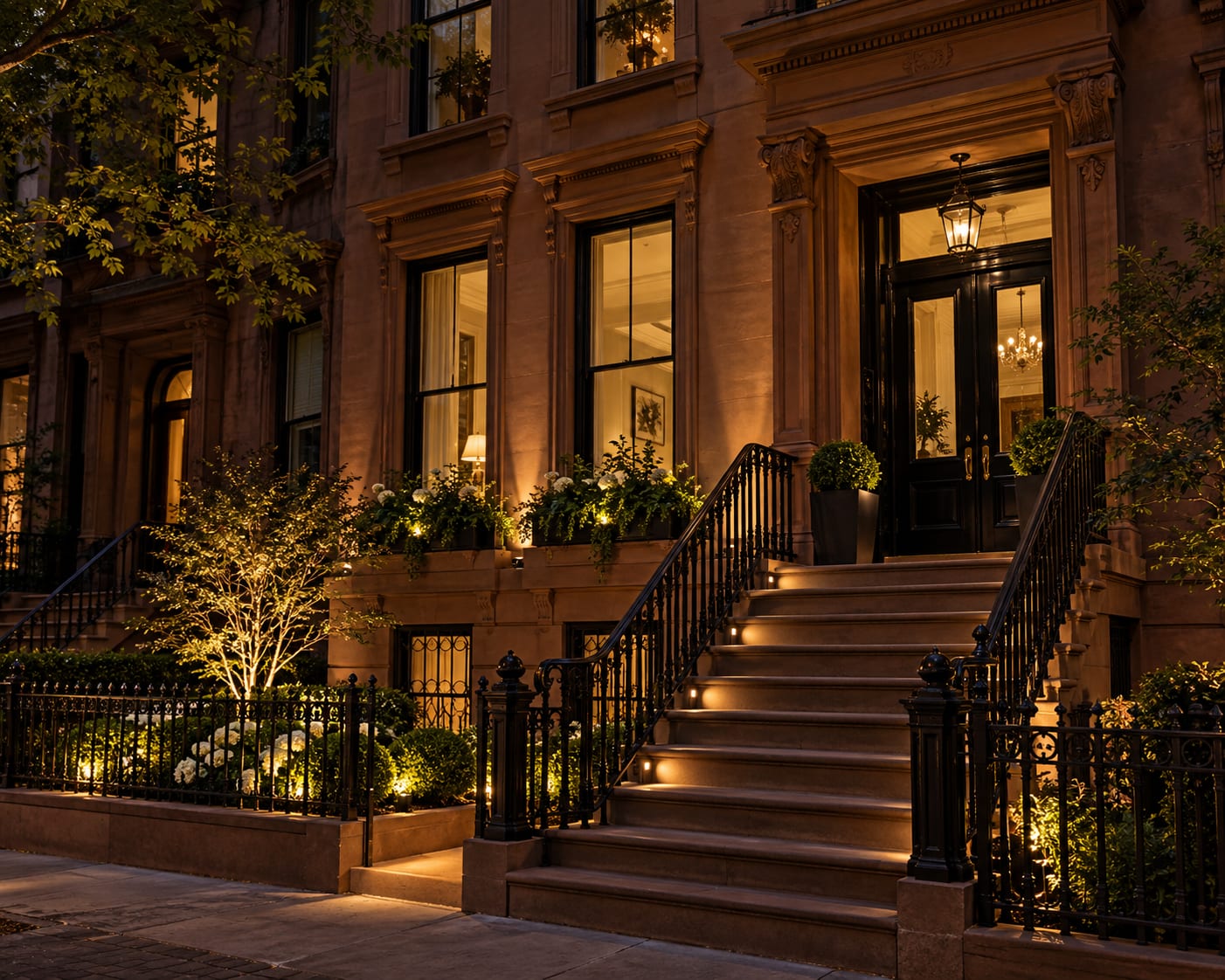
Brownstone Lighting Repairs: Restoring Safety Without Losing the Architecture
A dark stoop, a failed entry lantern or an unevenly lit garden deserves more than a replacement bulb. A thoughtful repair restores visibility while respecting the townhouse itself.
New York City brownstone lighting repairs require an unusual balance: reliable exterior illumination, architectural sensitivity and careful work around existing finishes. At Hamptons Landscape Lighting, the right starting point is a review of what works, what has failed and how the entire property should feel after dark.
Many brownstones and townhouses have been updated in stages. An original or reproduction lantern may sit beside newer surveillance lighting, a separate rear-garden system, discreet step fixtures and controls installed during different renovations. Each addition may work individually, yet the property can feel visually disconnected.
The best repair is not necessarily the brightest or most extensive. It is the one that solves the underlying issue and restores a coherent nighttime experience.
Have an exterior lighting problem?
Arrange an assessment of your townhouse entry, stoop or garden lighting before planning unnecessary replacement work.
What goes wrong with brownstone exterior lighting?
Brownstone lighting problems typically fall into three groups: failed electrical components, poor placement and design inconsistencies introduced over time.
Failures & wear
Failed entry lanterns, moisture-damaged sockets, corroded connections, damaged garden cable and unreliable timers or controls.
Comfort & visibility
Dark steps, harsh floodlights, exposed light sources, reflected glare and spill light reaching neighboring windows.
Design & coordination
Mixed color temperatures, mismatched fixtures, visible surface wiring and additions that compete with the architecture.
When several problems appear together, a structured exterior lighting repair assessment is more useful than repeatedly swapping individual fixtures.
Start with the stoop, steps and entry lantern
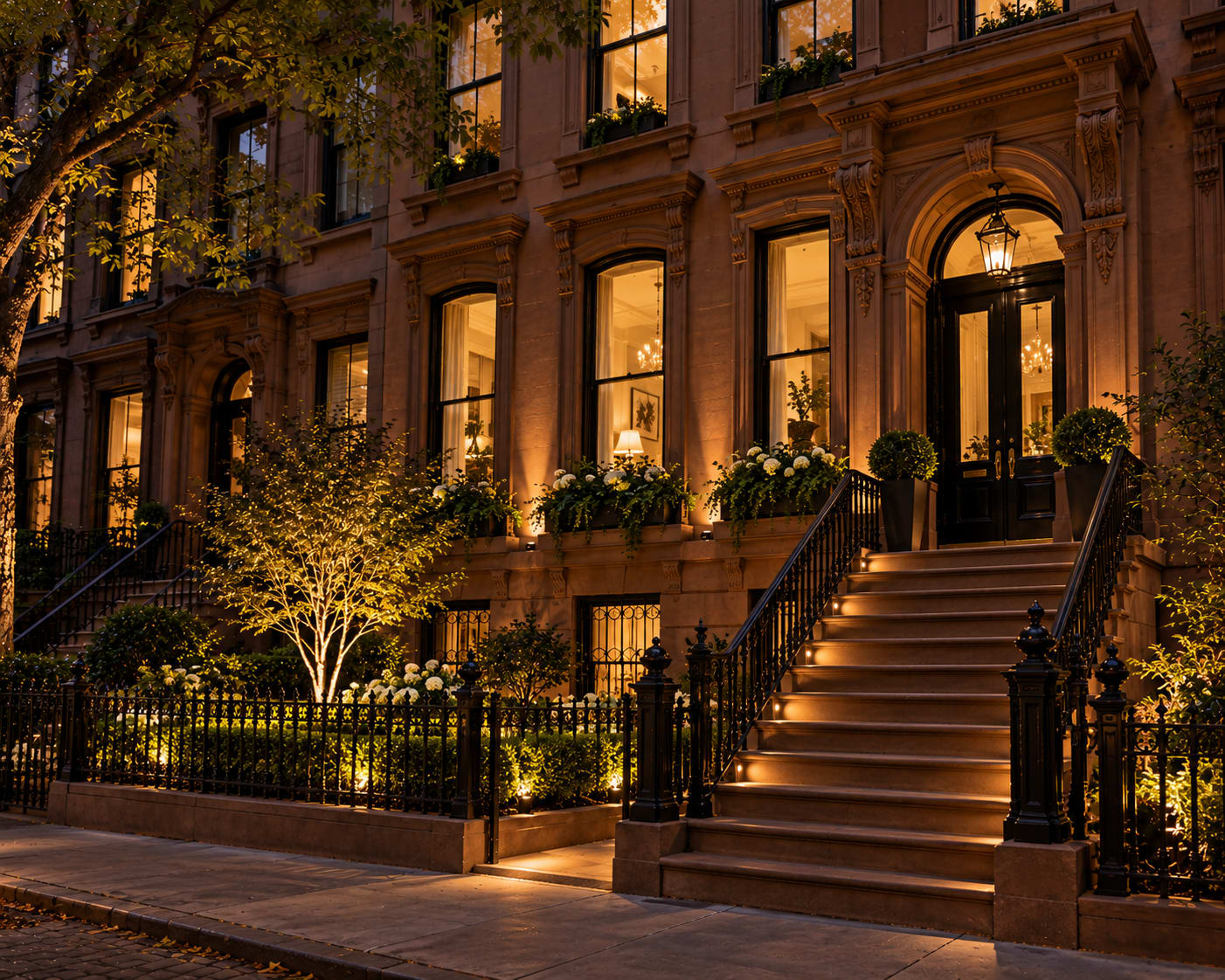
A brownstone entry needs to help residents and guests recognize the address, locate the door and move confidently over steps or changes in level. It should not turn the entire façade into a brightly illuminated surface.
Sometimes the existing lantern can be retained and its lamp or internal components evaluated for restoration. In other cases, a more discreet step-lighting detail, shielded source or updated control schedule will do more to improve the entrance than increasing wattage.
Because glare can make the edges of steps harder to distinguish, thoughtful placement matters as much as output. Our article on comfortable pathway and step lighting explains how small pools of controlled light can guide movement without a row of conspicuous fixtures.

Protect the character of the façade
Brownstone, limestone, brick, carved trim and wrought iron all react differently to exterior light. Strong frontal illumination often flattens texture, exaggerates flaws and competes with the depth of historic materials.
Selective illumination can be more effective. A carefully aimed beam might reveal an entry surround, a doorway or a textured surface while leaving adjacent masonry in softer shadow. If a fixture or wiring route must change, mounting options should be discussed before new penetrations are made.
Design principle: Preserve the original fixture where practical, keep new equipment visually quiet and make the architecture, not the light source, the focal point.
This is why we approach architectural illumination as part of a broader exterior lighting design, rather than a series of independent fixture decisions. For a closer look at the process, see how thoughtful landscape lighting is planned around a property.
The rear garden needs its own lighting review
Behind the house, the lighting conditions can be completely different. Narrow gardens, patio steps, planted borders and terraces often have low-voltage systems modified several times as the landscape evolved.
Moisture, buried connections, damaged wiring and fixtures obscured by mature plants may cause intermittent failures or uneven illumination. An evaluation can determine whether targeted rewiring, resealing, replacement or careful re-aiming will restore the space.
The objective is to make the garden inviting from both the terrace and the interior rooms overlooking it. The glare-control principles in our outdoor lighting guide are particularly relevant when windows, outdoor seating and neighboring properties sit close together.
Consider the neighbors, not just the property line
On a close-set NYC block, a poorly aimed fixture can shine directly into a neighboring window. Higher output does not automatically make a stoop, pathway or rear garden safer or more usable.
Weigh shielding, beam direction, brightness, mounting height and operating schedules from several viewpoints: the sidewalk, the entry steps, the neighboring windows and the view from inside the townhouse. Better control usually creates a calmer result for everyone.
Related reading: how to avoid the glare tax and why nighttime aiming matters.
Diagnose the wiring before opening finished surfaces
Electrical work in a finished brownstone can be difficult when original cable routes are undocumented or access is limited. Opening masonry, a finished interior wall or garden paving should not be the first diagnostic step.
A useful assessment starts with the available fixtures, visible connections, power supplies, timers and controls. Where required, a licensed electrician and the owner's renovation team should coordinate any line-voltage work or concealed wiring changes. Historic-district or building approvals may also affect exterior fixture replacement and mounting decisions.
When a larger renovation is planned, discussing exterior lighting with the architect, general contractor and electrician early can protect finished surfaces and allow future service access.
Repair, retrofit or replace: how should you decide?
Repair
Best when the fixture character is right and a specific fault, such as a failed connection or lamp component, can be corrected.
Retrofit
Useful when a valued fixture can support an appropriate modern light source or more reliable controls after compatibility review.
Replace selectively
Appropriate when fixtures are damaged beyond practical repair, create persistent glare or no longer suit the architecture.
There is no universal answer. The condition of the fixture, wiring, controls, existing mounting and architectural context all matter. For a broader decision framework, read whether to repair or upgrade an existing lighting system.
Bring different eras of lighting into one composition
Even after individual failures are resolved, the entry, garden and façade may still feel unrelated. A cohesive update looks at color temperature, beam spread, visual hierarchy, timer settings and controls together.
A warm entry lantern can remain the focal point while restrained step lights help define the stoop. In the back garden, discreet path and planting illumination can make outdoor spaces feel connected without turning on every fixture at full output.
Appropriate lighting zones and control scenes may help coordinate these areas while allowing the property to become quieter later in the evening. Ongoing attention also matters. Our Brilliance Care maintenance program explains the role of cleaning, re-aiming and checking controls after installation.
Frequently asked questions about brownstone lighting repairs
Can an original brownstone entry lantern be repaired instead of replaced?
Often it can be evaluated for repair or retrofit, but the answer depends on its condition, construction and electrical safety. Preservation of the original appearance should be considered alongside reliable performance.
Can HLL help with both low-voltage garden lighting and line-voltage exterior fixtures?
HLL can evaluate the existing exterior lighting arrangement and recommend a repair or upgrade approach. Work involving line-voltage infrastructure may require a licensed electrician.
Do brownstone lighting repairs require opening the masonry?
Not always. Testing accessible fixtures, wiring, connections, power supplies and controls can identify issues before invasive work is considered. Any proposed penetrations should be coordinated with the building team, especially where historic materials are involved.
Can older townhouse lighting work with modern lighting controls?
Sometimes. Compatibility depends on the existing wiring, loads, fixture technology and desired schedules or scenes. A site evaluation is needed before recommending a retrofit.
How do you improve entry visibility without shining into neighboring windows?
Use shielded sources, modest output, appropriate mounting positions and careful aiming. Test from the steps, sidewalk and nearby windows after dark, rather than relying on brightness alone.
Should we repair the system before a townhouse renovation?
It helps to assess the existing exterior lighting early in the renovation planning process. The architect, contractor and electrician can then account for wiring routes, fixture locations, mounting and control infrastructure before finishes are closed.