
Landscape lighting maintenance / Repair & upgrades
What to Do When Your Landscape Lights Stop Working
A thoughtful diagnosis can bring a dark system back to life, and restore the lighting design that made your property feel complete after sunset.
A landscape lighting system can fail all at once, one fixture at a time, or so gradually that the property simply stops looking the way it once did. When outdoor lights stop working, the right first step is a complete diagnosis, not a series of isolated replacements.
At Hamptons Landscape Lighting (HLL), we evaluate, repair, and improve existing outdoor lighting systems across Southampton, East Hampton, Sag Harbor, Bridgehampton, Water Mill, Montauk, and the surrounding East End. Our landscape lighting repair service considers how the system operates and how the property looks at night.
Safety first. If wiring is exposed, a fixture is broken, a transformer is wet, or a breaker keeps tripping, leave the affected equipment alone and arrange a qualified inspection. Do not repeatedly reset the circuit or work on energized components.
Why landscape lights stop working
A dark fixture does not always mean the fixture itself has failed. The fault may be in a shared circuit, a connection, or the control system.
- Corroded or damaged connections
- Underground cables cut during landscaping
- Failed lamps, LEDs, or drivers
- Moisture inside a fixture
- Transformer, timer, or control issues
- Excessive circuit load or inadequate voltage
- Tripped breakers or GFCI protection
- Salt exposure, irrigation, or storm damage
Several faults can produce the same symptom. Replacing a bulb without testing the affected circuit may miss the underlying cause.
What professional troubleshooting should include
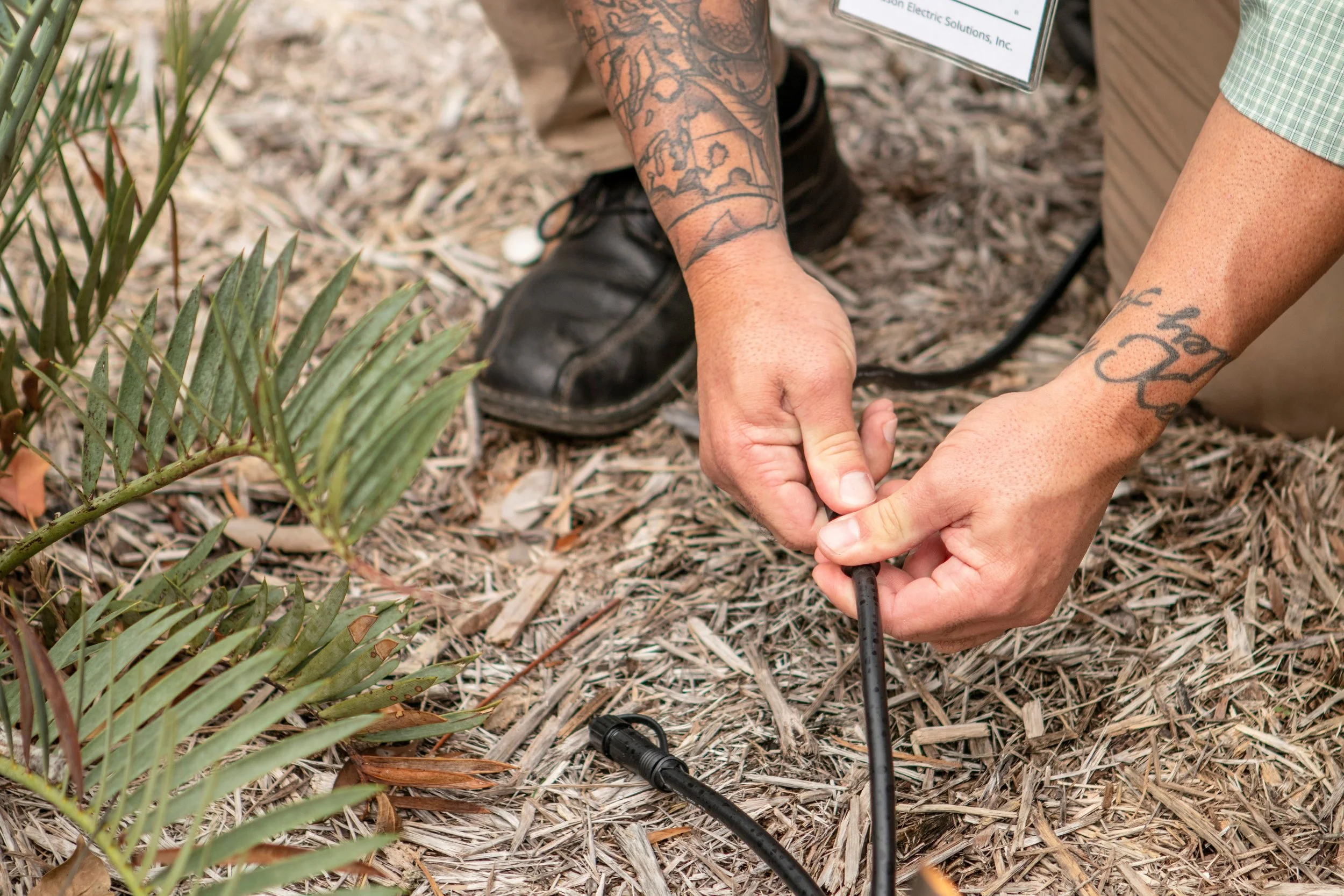
A useful service visit begins with the entire system. A technician may inspect the transformer and available controls, trace affected circuits, test voltage, assess connections and fixtures, and check for signs of moisture or physical damage.
Then comes a second question: Is the lighting merely turning on, or is it still creating the intended nighttime experience? A system can operate while leaving paths too dark, producing uncomfortable glare, or overlooking mature trees and new planting beds.
Diagnose the failure
Identify the cause rather than guessing from the symptom.
Evaluate what can be kept
Review existing wiring, fixtures, controls, and transformers for condition and compatibility.
Restore and refine
Complete the appropriate repairs, then assess coverage, glare, and aiming after dark.
Can an older lighting system be repaired?
Often, yes. Existing components should be assessed individually. Sound wiring or serviceable fixtures may be worth retaining, while failed connections, damaged equipment, or poorly placed lights are addressed selectively.
A repair is also an opportunity to improve long-standing problems, such as inconsistent color temperature, exposed glare, mixed fixture finishes, improvised connections, or areas that have become dark as the landscape has grown.
Repair or replace: how to decide
Repair may make sense when…
The issue is localized, the remaining equipment is sound, and the system can be safely serviced with compatible components.
Replacement may make sense when…
Widespread corrosion, repeated failures, inaccessible wiring, or incompatible equipment make continued spot repairs unreliable.
HLL explains which parts can reasonably stay, what caused the failure, and where an upgrade would provide a meaningful improvement. The goal is an informed decision, not an automatic recommendation to replace everything.
Why the nighttime evaluation matters
Outdoor lighting cannot be fully judged in daylight. Once operation is restored, nighttime evaluation reveals whether beams are correctly directed, important features remain dark, or the composition feels uneven.
Small changes to fixture position, shielding, intensity, or beam spread can restore the balance of a garden, arrival sequence, or architectural facade. For more on the relationship between repair and night aiming, see our guide to landscape lighting damage, repair, and aiming.
Keep the system working as the property evolves
Salt air, storm exposure, irrigation, shifting soil, and fast-growing plantings all affect exterior lighting in the Hamptons. Seasonal checks can reveal corrosion, obstructed fixtures, loose connections, and aiming changes before they become larger problems.
Through Brilliance Care™, HLL provides ongoing cleaning, inspection, re-aiming, and recommendations appropriate to the property.
Frequently asked questions
Can HLL repair lighting installed by another company?
Yes. We assess an existing system based on its condition, safety, serviceability, and design potential, regardless of who installed it.
Why do only some of my landscape lights work?
A partial outage may indicate damage to one circuit or connection, voltage loss, a failed component, or a control issue. Testing determines the actual cause.
Do you offer emergency outdoor lighting repairs?
Service availability depends on location, system condition, and scheduling. Contact HLL with details about the affected areas and any recent landscape work or storm damage.
Repair / Re-aim / Maintain
Make your landscape lighting feel complete again.
Whether a few fixtures have gone dark or the entire system needs attention, we can evaluate the installation and recommend a clear path forward.
What to Do When the Lights Stop Working
A landscape lighting system can fail all at once, one fixture at a time, or so gradually that the property simply stops looking the way it once did. For homeowners searching for landscape lighting repair in the Hamptons—or “outdoor lighting repair near me”—the first step should be a complete diagnosis rather than a series of isolated, hit-or-miss replacements.
At Hamptons Landscape Lighting (HLL), we repair and improve existing outdoor lighting systems throughout Southampton, East Hampton, Sag Harbor, Bridgehampton, Water Mill, Montauk, and the surrounding East End.
Why landscape lights stop working
A dark fixture does not necessarily mean the fixture itself has failed. The problem may be elsewhere in the system, including: